Categories

art (2) culture (4) flora (17) gov (23) grinds (25) hale (10) hiking (25) lit (3) local (54) log (3) maui (5) meta (16) politics (8) recipe (6) relo (11) travel (70)
Showing posts with label politics. Show all posts

August 10, 2014

Primary election results

The election results from yesterday's primary are in (not official final yet but the writing is on the wall).
Here's my analysis of the local races for mayor and county council.
  • Incumbent Mayor Carvalho looks on track to re-election.
  • Most of the incumbent county council members are leading the pack, with newcomer Arryl Kaneshiro placing an impressive third.
Overall, the prospects for any kind of change seem small to none.

Mayor

Mayor Carvalho did well against a well organized challenge from Dustin Barca (former pro surfer and mixed martial arts fighter). Clearly the incumbent mayor was expected to do well but I saw a lot more Barca signs and he made news with his run around the island. By percentage you can see (below) that The Mayor is weakest on the north shore which is where Barca's strength is. Barca's won't have a chance in the general general election unless he can compete with The Mayor in Lihue, south side, or (where I expect his best chances would be) west side.

NOTE: The precincts numbers below from Hanalei 14-01 working around the highway (clockwise) toward the west side winding up Niihau 16-06. 
BARCACARVALHO
14-0125.94%12.63%
14-0229.47%14.85%
14-0319.22%22.80%
14-0415.52%25.47%
14-0511.95%28.04%
15-0117.11%24.58%
15-027.93%30.92%
15-038.49%34.56%
15-049.79%33.71%
15-0514.73%26.24%
16-0114.19%24.16%
16-0214.18%29.59%
16-037.55%32.44%
16-0410.88%35.11%
16-058.13%33.04%
16-062.08%40.63%

County Council

For all the talk out there about dissatisfaction with county government, I was a little surprised to see the very same names leading the pack. 
  • Only Arryl Kaneshiro beat any elected incumbent. As an employee of Grove Farm, one of the biggest land holders on the island, I wonder how he will be an independent voice of the people.
  • Incumbent Mason Chock, Sr. (who I think is one of our best council members) was appointed, not elected, and has the farthest to come to get re-elected.
  • Kualiʻi who finished eighth (just below getting on the council) is poised in that position again.
  • Police Chief Perry is also close to getting in (impressive since I can't recall seeing a Perry sign).
  • Billy DeCosta ("Don't be silly, vote for Billy.") made a stronger showing than I expected.
The results are shown below (based on latest official results as of 08/10/2014 at 03:16:25 am) with candidates in the top seven (who would be elected if this were the general election) in bold, and below the cutoff (14) to get into the general election shown grayed out in italics.

CandidateVotes
RAPOZO9,592
KAGAWA9,387
KANESHIRO8,173
YUKIMURA7,252
FURFARO6,868
HOOSER6,642
BYNUM5,839
KUALIʻI5,525
PERRY4,902
CHOCK4,672
BRUN4,577
COWDEN4,524
DeCOSTA4,243
LARANIO3,754
KATO-KLUTKE3,409
KANEKOA3,056
KAAUWAI2,243
GEORGI2,102
LEONG1,816
HOROSHKO801

Finally, I would like to thank all the candidates, including Ron Horoshko who runs Birdie's restaurant at the Kukuiolono golf course, for participating in our democracy.

July 30, 2014

Kauaʻi County annual report

Kauaʻi county publishes an annual report summarizing the activities of each department for the past fiscal year. The 2012-2013 report is just out and can be found here.

The county fiscal year is from July to June, so that means it took nearly 13 months to get the report out this year. I wrote to the mayor's office asking why the delay and with persistence heard this year they took extra time without an explanation of why. Normally the report is out by late fall they said.

A few highlights from reading a few sections:

  • County Auditor
    • The review of county take-home car policy (notably including the gas the county pays for that allegedly went to personal use) is still in progress.
    • County Auditor returned 36% of the budget unused
  • County Attorney
    • almost $500,000 over budget (apparently unplanned high cost of litigation)
    • the county is embroiled in lawsuits against it: well over 100 cases were pending at the start of the fiscal year (two years ago, July 1, 2012) and just over 100 were filed during FY2012-2013; since only 50-some cases closed that means the county had nearly 200 cases pending as of June 30, 2013.
  • Mayor
    • a collection of reports from a number of boards and projects under the mayor's office
There are a total of 19 department sections in the county annual report. I will update with highlights from a few more at a time.

Fiscal Year 2012 - 2013 Annual Report by Department

Message from the Mayor
Table of Contents
Section I: Office of the County Attorney
Section II: Civil Defense Agency
Section III: Department of Personnel Services
Section IV: Office of Economic Development
Section V: Agency on Elderly Affairs
Section VI: Department of Finance
Section VII: Kauai Fire Department
Section VIII: Kauai County Housing Agency
Section IX: Department of Liquor Control
Section X: Office of the Mayor
Section XI: Department of Parks & Recreation
Section XII: Planning Department
Section XIII: Kauai Police Department
Section XIV: Office of the Prosecuting Attorney
Section XV: Department of Public Works
Section XVI: Transportation Agency
Section XVII: Department of Water
Section XVIII: Office of the County Clerk
Section XIX: Office of the County Auditor

April 20, 2014

The coming GMO battle: Kauai Charter Amendment Article XXXIII

As the ongoing legal wrangling over Kauai's Ordinance 960 continues, the next wave of political action is rolling out as a county charter amendment (full text) from Kauai Rising who has begun collecting signatures to put the charter amendment on the November ballot.
ARTICLE XXXIII - BILL OF RIGHTS 
TO PROTECT FROM HAZARDS OF GMO AGRICULTURE, TOXINS AND TESTING, ESTABLISH AN ADMINISTRATOR OF ENVIRONMENTAL HEALTH, AND PROVIDE FOR ENFORCEMENT
GMO issues are complex and I won't attempt a position here. Without attempting a legal analysis either here are some first observations.

The amendment establishes a County Administrator of Environmental Health and a "panel of experts" that would report findings to the county council to approve any GMO activities on the island, with a provision allowing the council's decision to be overturned subject to petition by the public. Additionally there would be a monitoring effort, a containment requirement to prevent impact on neighboring property. All costs and overhead would be funded through what would have to be very expensive application fees and there would be significant civil as well as criminal penalties for violations.

The amendment begins with a detailed enumeration of rights: safe food, clean environment, protect communities, saving seed. The assertion of rights seems intended to address the legal challenge of local government typically being trumped by state and federal as I have written about previously.

The full amendment is 18 pages long - Kauai Rising provides a very brief summary. On the face of it the amendment appears to be a much stronger version of Ordinance 960 (which only required annual reporting of GMO activities and was largely about pesticide use and buffer zones) that squarely tackles GMO operations. Under the amendment, GMO operations would be required to demonstrate "beyond a reasonable doubt," that none of the rights are harmed.

The length of the charter amendment I find quite curious: this is about 25% the size of the entire county charter (72 pages). County departments like police, fire, water, and so forth each take up about two pages in the county charter. Is it really wise to embody so much detail in the charter itself rather than in ordinances and rules as the county generally operates? There does not seem to be a way to bundle a charter amendment with legislation accompanying it which is why I imagine the authors have piled all the details in, the alternative being a separate law-making effort that would become yet another battle.

Kauai Rising seems to be the authors of the amendment as I can find it nowhere else on the web. Who actually wrote the amendment and with what legal help is unclear. There is not much press on this yet. Kauai Eclectic is dismissive of the effort.

Throughout the battle over "The bill" (Bill 2491 which became Ordinance 960) there were vague claims that its passage would result in loss of jobs that I thought exaggerated. The amendment, on the other hand, seems a clear threat to the currently operating chemical companies and its passage (surely to be challenged in the courts) would very much be an existential threat to operations here. The stakes are much higher indeed if this manages to get on the ballot. Charter amendments require signatures of 5% of registered voters to get on the ballot.

January 30, 2014

State of Hawaii vs. County of Kauaʻi

Following close on the heels of the legal suit over Kauaiʻs Ordinance 960 (formerly Bill 2491), two bills have been introduced at the state level - House Bill 2506 and Senate Bill 3058 - that would have that “No law, ordinance, or resolution of any unit of local government shall be enacted that abridges the right of farmers and ranchers to employ agricultural technology, modern livestock production, and ranching practices ..."
Update: This very same language is in another piece of legislation as Senate Bill 110 and not adopted in committee (4 Feb 2014).
They might as well just have stated clearly: we don't trust counties to have the sense to have a say about how farms and ranches operate on their own islands.

Local law is already very much subject to override by state which is in turn subordinate to federal law (as I wrote about previously including the less well known legal principle called Dillonʻs rule which further limits the purvey local government to only those subjects they are explicitly empowered to legislate). That some state legislators feel compelled to specifically forbid local ordinances in the realm of agriculture can only be interpreted as a simple lack of trust.

According to a recent editorial in The Garden Island - and it may be a first for the latest Oahu-controlled incarnation of that periodical that I agree with this one - two local Kauai representatives in the state legislature are the ones introducing this legislation: Rep. Dee Morikawa (D-Koloa-Niihau) and Rep. James Tokioka (D-Koloa-Wailua). They seem to see their vital role at the state level as being about blocking our county council from bothering to get involved with things agricultural on the island.

The hubris of disempowering local government in perpetuity is astounding in itself, much less on the heels of the dramatic events on Kauai over the past several months that if anything clearly demonstrate how vital these issues are for so many folks here. Since the state level status quo - understaffed, minimal regulation and a voluntary program concocted in the eleventh hour ahead of Kauai 960 (2491) - is quite favorable to the big corporations, one has to assume that in writing off the anti-GMO crowd these representatives owe a heavy allegiance to the other side.

However, I donʻt want to underestimate the subtlety of the issues nor the intricacies of the power plays. Over at Kauai Eclectic, Joan raises some good questions about how fit Kauai is to self-govern. I would agree that the debate here - 2491 being just one prominent example - was less than statesman-like and that rational, well reasoned opinion was in very short supply.

So I would say that yes, Kauai has a lot of room for improvement, but then I would also say that at the state and federal levels - even at the UN - government could do a much better job as well. Be that as it may, local government certainly has a vital role to play here and I would need a lot better argument than “It’s a right to farm bill,” before we irrevocably disempower the counties. In the end inclusive government that respects locale must be the best system: suppressing local control always amounts to suppression of the weaker county by the more powerful state, and that just isnʻt democratic, or even moral.

I have seen it reported that these bills are not expected to get very far and the threat of passing appears small now, but that Kauai's own representatives are doing these maneuvers in the first place is unsettling, and of course, predicting the future of legislation is hardly reliable.

November 16, 2013

Bill 2491 becomes law

Bill No. 2491, Draft 2 - A BILL FOR AN ORDINANCE TO AMEND THE KAUA’I COUNTY CODE 1987, AS AMENDED, BY ADDING A NEW ARTICLE 22 TO CHAPTER 22, RELATING TO PESTICIDES AND GENETICALLY MODIFIED ORGANISMS (Laid on Table 11/07/2013)
The Kauaʻi County Council today voted to override the mayor's veto of Bill 2491 - 5 to 2 - in another dramatic turn of events in the GMO struggle unfolding on the island.

Five votes were needed to override the veto, and up until yesterday the council stood at six members, but just yesterday Mason Chock was appointed to fill the vacancy and it turns out that he cast the deciding vote. After voting for the bill last month, Nadine Nakamura resigned from the council to become the mayor's managing director, removing one likely override vote from contention.

After having signaled that they would vote on the override one member short, the council on Thursday they voted to table the veto override vote; on Friday they appointed Mason Chock to the council; then on Saturday they overrode the veto.

Meanwhile, spurred by all the 2491 hubbub, earlier this week at the state level there was an announcement of a new "good neighbor" program (PDF) consisting of entirely voluntary notification, reporting, and the establishment of buffer zones.

The county has nine months to prepare to implement the new law and there are sure to be many twists and turns between now and then.

Links:


October 14, 2013

Dr. Pang on GMO in Kaua'i

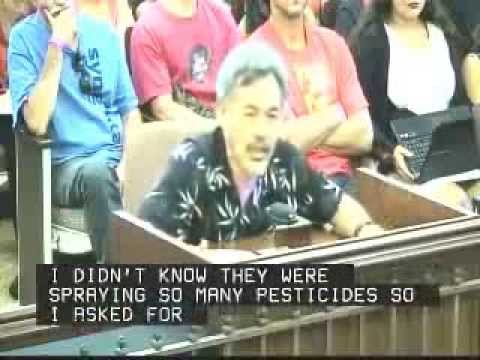
Today I learned about Dr. Pang, watched his recent testimony on Kaua'i about Bill 2491 and GMO, and found it compelling. While 100% of what he says may not be perfect, this overall message is the best thought out and well reasoned I have yet to seen by far. It's must-see (linked above) if you care about this issue.

Dr. Pang makes a number of excellent points that I won't attempt to condense and summarize here - he is the expert and speaks for himself most capably.

Speaking for myself, not an expert, my key takeaway that I found convincing is his appeal to disclosure: the first thing that we must do is to get the companies doing this work to log and report on their activities. The reasoning is quite straightforward: without solid information it's impossible to do any kind of scientific investigation at all. Only when we have actual data can we begin to look into claims of harm as well as exonerate the same activities from culpability. Absent reliable data, everything remains unclear, nothing can be proven one way or the other. (Again, this just touches on one part of he presentation and following Q&A in the video, but it's such a fundamental point I think it's worth focus.)

He anticipates and counters a number of obvious possible objections, but the bottom line here is even if it is imperfect data, even if the county cannot rigorously enforce accurate and full disclosure, collection of data enables science going forward. We can improve on data quality and quantity, compliance over time but the longer we delay we lose the opportunity to gather data at all in the present. Surely any responsible business already has all of this data and more internally. To the degree details are confidential the county should be trustworthy to keep it private, or only publish digests to interested parties such as researchers that would not reveal proprietary business intelligence inappropriately. Providing data about operations to the county cannot be a major expense at the scale these companies operate, nor is it at all a threat to their business.

Also the analogy Dr. Pang draws to sugar cane burning oversight on Maui seemed relevant and promising. Companies are obliged to log and report whenever they plan to burn cane fields, an essential part of the growing cycle for sugar cane. They provide the county details such as location, area, wind conditions before and after, and so forth. The county in turn can not establish buffer zones or warn citizens as appropriate given the information. Relating this back to GMO and Bill 2491, Dr. Pang aptly noted that ideally the county should get disclosure first and based on that information it could better set effective buffer zones rather than pre-establish buffers in the bill itself; however, he concurred that if the situation was deemed urgent then early setting of buffers arbitrarily was reasonable.

Additionally, Dr. Pang recommended (which Bill 2491 does not do) getting disclosure of the specific GMO mutations being released into the environment. This makes good sense as basic data gathering practice. There was confusion in Q&A, but I believe what this means is disclosure of the type of GMO product (for example, in the case of corn, is it herbicide-resistant or insecticide-producing).

We will see if touching on this topic leads to vociferous responses in the comments: I welcome input so long as it is respectful and backed by evidence cited (see below for my part; naturally, Dr. Pang backs up his statements with citations himself). Should anyone reading this disagree with my takeaway, I would invite them to comment, and only ask for a specific response ("disclosure" below means per Sec. 22-22.4 of Kauai County Bill 2491). Here are a few points I would like to see anybody's best rebuttal:

  1. How would reasonable disclosure make the situation significantly worse?
  2. If required disclosure is onerous to business, exactly how, and what are the major costs and impacts incurred?
  3. Without real data from required disclosure, how can government or independent researchers possibly study the impact of GMO on west Kaua'i communities at all?

Background info:


May 4, 2013

Toward a Kaua'i Bill of Rights

Thursday evening Kaua'i Rising held an informational event featuring two lawyers from the CELDF talking about environmental challenges to local communities and their strategies and efforts to support people standing up for their rights. The three hour meeting was quite interesting and felt like about half that much time and was embedded in a cultural context with music and Hawaiian style opening and closings.

Kai Huschke and Ben Price from CELDF spoke at length as lawyers who has worked with numerous communities fighting large corporate interests they do not want exploiting their land - energy extractions such as tracking, strip mining, big agriculture.

They also described how the legal and political systems of this country are stacked heavily against local control. I knew well that in the hierarchy of our legal system federal law is supreme, then state, and finally local law, but the obvious effect of this structure had not in so many words occurred to me: local control is systemically quashed. On top of that there is Dillon's Rule which states that municipal law can only legislate matters expressly granted to it by federal or state law, or enshrined in the charter of the municipality. (For more than the preceding simplified sketch of the legal terrain, see the CELDF site resources with in-depth and authoritative legal information.)

Prospects may sound bleak for a grass roots reversal and in some ways that is so. On Kaua'i the hot button topic is GMO because the former cane sugar fields have been turned over to GMO seed production and experimentation, exploiting the year round growing conditions and plentiful water here. For more info on GMO issues see for example hawaiiseed.org.

John Dumas played a beautiful opening set while people assembled and then closed the meeting with a heartfelt rendition of Amazing Grace [download].

The political and legal strategy is complex and I won't attempt to describe it here much less evaluate options. One key point to understand about this meeting is that where it was crystal clear where the CELDF comes down on these issues, they were equally clear in their role in coming here being to advise options for the community to chose action. In a nutshell, there are three options to choose from:

  1. Do nothing: you get the status quo and all prospects for escalation by corporate interests.
  2. Regulate within the existing legal framework: you may get some concessions but not stop anything, and by doing so legitimize the activity and thereby contribute to its expansion.
  3. Fight back: exactly what forms this takes and what the likelihood for victory may be remains to be seen. The glimmer of hope on the legal front is an argument built on the principles of human rights which government is responsible to protect and serve, not subjugate. Ultimately, it's a moral responsibility as well for the people to protect the land and nature.
In closing I would like to capture some excepts from the meeting out of context that I think best convey the spirit of it.
  • Big corporations become The Machine of Endless Production of More
  • One community resisting corporate exploitation was labeled by law enforcement as domestic terrorists, so they had T-shirts made up and wore them proudly.
  • The legal strategy CELDF helps crafts becomes an organizing strategy.
  • US law is based on English law which developed to support the process of colonization, so it encourages expansion of empire, wiping out local customs and practices to be replaced with by the new masters of newly acquired territories.
  • The US constitution is largely a collection of commerce and property law. (The Bill of Rights is separate.)
  • The CELDF used to carefully review corporate applications for extractive operations and point out all the errors and flaws to get them rejected. However, they soon stopped doing this because the corporations would just make exactly those corrections and refile. In effect, the CELDF realized they were providing corporations free legal services and legitimizing their operations.
  • Responding to a comment wishing more people were at the event (I'd say it was less than 100), a wonderful auntie stood up and said, "The people who need to be here are here."
  • Ben Price related a wonderful quote from working with an indigenous community. Upon learning about Dillon's Rule that municipalities are completely subject to federal and state control, an older Native American in attendance said, "So municipalities are the white man's reservation ... only he doesn't even know he's on a reservation, too."

May 1, 2013

Action for Kaua'i Rising

Today I had planned to go to the beach, up until 10:30pm last night that is when a friend here forwarded me email about a Kaua'i Rising action to petition the county council at a public meeting this morning to adopt a Kaua'i Food Bill of Rights. Clearly this was the place to go. And then, on the way there, who should I see at a Kapa'a bus stop but my friend (who does not have a car) it turned out that we went to the event together and he kindly introduced me around.

On Kaua'i because it is small and isolated and so many people come here for such different reasons it seems that modern challenges with food, energy, economics, and so forth come to a head quickly and in more extreme ways than on the mainland. This is, of course, also an enormous opportunity.

Gathering at 8am ahead of a county council hearing where a large number of signed petitions were to be presented I met a lot of the people attending the action. The diverse gathering was about half what would be characterized as counter-culture people, a number of retired persons, and a few locals. I met numerous good people who quickly made me feel welcome and had some good conversations about these difficult issues. Some council members came out and met with people individually ahead of the formalities, and even the chief of police made an appearance.

The action began with music - drums and singing; and included petition collecting, signs like "GMO Free Hawaii!", and a lot of impromptu talk story. At around 9am a contingent went in to present the petitions and address the council while the signs and music continued outside.

I met a young lady who left her career in marketing to come here and run a small business and now describes herself as an orchestrator. I met a massage therapist who told me that Kaua'i is a remnant of the lost continent of Lemuria. I met the web site administrator for the Kaua'i Rising web site.

Afterwards, a lady who had gone in described the proceedings. She spoke softly and with such a loving tone about the disparity between the very human energy of this action and the petition and the people behind it against the calculated complexity of county council procedures and rules. "They spent twenty minutes deciding how we could use the eighteen minutes we were allotted to speak." It was a striking example of modern government inefficiency and how they become entangled in their own rules. By contrast, she offered that what was needed was more "speaking from the heart" which was exactly what all those people were there doing in their own way, myself included.

Next steps: there is a meeting tomorrow (6:30pm, May 2, in Kapa'a at The Children of the Land) to present a draft of the Kaua'i Food Bill of Rights for public input that I intend to attend to learn more about what specifically it entails. I will postpone touching on the issue and this strategy here, focusing instead on the gathering and that experience.

Update: read the Kaua'i Rising post following today's event here with details of Thursday meeting.

Update: Garden Island story on this event is here. I happened to be standing behind the "PETITIONS DROP OFF" sign in the 3rd photo labeled "collect FOOD BILL.jpg" and unrecognizable.

Update: Interesting critique of the action - I did not have a chance to go inside and observe the actual meeting as the room filled up - from Joan Conrow, my favorite local investigative blogger.